


On Our Minds
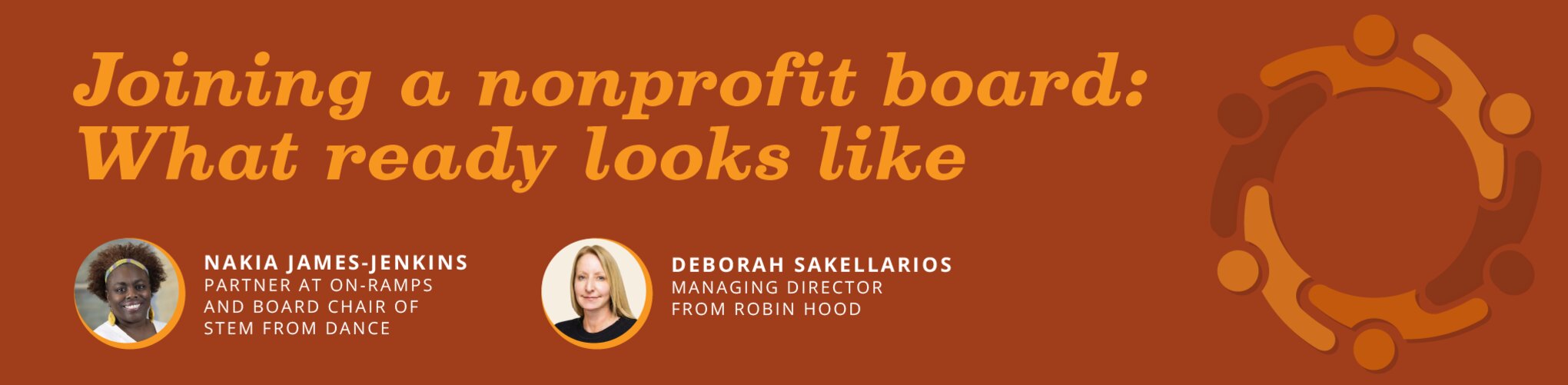
As a Partner at On-Ramps and Board Chair of STEM from Dance, I get some version of this question constantly: how do I know if I’m ready to join a board? I asked Deborah Sakellarios, who leads Robin Hood’s Management Acceleration team, home to its Board Placement Program, to think through it with me. Here are our thoughts.
Start with your why
Deb defines board readiness through two lenses: your professional background and your motivation to give back to the nonprofit sector. Robin Hood’s board placement program specifically seeks leaders with approximately seven years of professional experience—enough to have reached a point in their careers where they can commit meaningful time, resources, and network access to a board .
But she’s also clear that readiness isn’t just about hitting a time or experience threshold. A leader needs to be able to roll up their sleeves on a committee, take the time to learn the sector they’re joining, and act as a genuine advocate. As she put it, “We really are looking for candidates who are committed to the mission of the nonprofit they join, not joining because they think it’s high-profile.
I constantly come back to one foundational question: do you know your ’why?’ Why join a board at all? Why this organization? Why right now? Those answers matter. They help build a clear sense of what you hope to gain from (and bring to) the experience. Board service is a commitment of time, judgment, relationships and leadership.
I’ve sat across from people whose why was thin, usually the next line on a resume, a way to expand their network, or an opportunity to stay visible after reaching a certain level in their career. Those things may be benefits of board services but they can’t be the foundation.
In fact, the why matters so much that it can outweigh many of the traditional markers we associate with board readiness. Deb and I agree that some of the strongest whys we’ve seen came from candidates who weren’t obvious fits on paper: newer, less experienced, but connected to the community an organization served, and deeply motivated about the value they’d add.
Know what you’re signing up for
Executives are trained to act. Boards are trained to deliberate. Watching a problem you can see clearly and trusting the executive director to solve it instead of solving it yourself takes discipline, especially when you’re emotionally invested in the mission.
But stepping back from the doing doesn’t mean stepping back from the weight of responsibility. As a board member your duties will include acting in the organization’s best interest, staying free of conflicts, and making sure it operates within its own rules and the law. In practice, that fiduciary responsibility means learning how nonprofit finances may differ from what you’re used to—since they don’t work like private-sector finances—and making sure you know how to read and accurately assess all the relevant financial documentation.
Recognize the skills you already have
For me, the clearest example is managing up. If you’ve influenced a board, a funder, or a boss without formal authority, chances are, you already understand how governance works, even if you’ve never used that language to describe it. The skill at the core of that is building trust without control, and it starts with a willingness to be vulnerable about your learning curve.
Deb pointed to something simpler: learning to pause. People coming from senior roles are used to jumping in immediately. Learning to sit back and figure out where you add value—instead of assuming—is its own skill and one that tends to make people better at their own jobs too.
Grow where you can and know where you can’t
Many of the skills you need inside a governing boardroom can be grown outside of one. But not every gap closes the same way or can be closed at all.
Deb points to junior boards—training grounds typically centered on fundraising — as a key resource. This experience allows early-career leaders with less board service, fewer resources, or smaller networks to get a feel for board membership before they’re ready to take a seat on a governing board.
As far as gaps that may not close, I’m skeptical about one in particular: temperament. Some leaders are built to lead from the front and struggle if they can’t be in the driver’s seat. Telling instead of advising puts strain on the relationship between the board and the organization’s leaders. That’s usually where things come apart. And, unfortunately, it’s not something more experience necessarily fixes. So be honest about your leadership style and the kind of dynamic you’re ready to commit to.
Find the right support
Ultimately, knowing your why, the extent of the commitment, and your skills and challenges gets you a lot of the way there, but it doesn’t automatically find you the right seat. That’s where a board placement program comes in. An exceptional one—like Robin Hood’s—is deeply invested in making as strongly aligned a match as possible, and they support leaders through every step of the journey whether they’re already serving or still deciding if board service is right for them at all.
Robin Hood starts with a well-informed, ongoing assessment of the organization, including its board structure and needs. Nonprofit needs shift with the political and economic climate: a stretch of funding cuts creates demand for board members who can handle crisis communication with donors; a period of legal uncertainty creates demand for attorneys; right now, it’s people who understand AI. Robin Hood’s job is finding leaders who are prepared to help organizations meet the moment.
They put the same effort into understanding candidates: what sector and organizational stage would most suit you, the culture you need to thrive, and the skills you’re most prepared to utilize. Much like the way Robin Hood identifies priorities and implements solutions for its community partners, the board placement process is built to match candidates thoughtfully, pairing people who bring diversity of identity and skillset with the organizations that need it most. They even cover things candidates may not know to ask about—like confirming the board they’re joining carries D&O insurance, which helps protect members navigating the fiduciary liability of board membership.
In Deb’s words: "It’s a high-touch process where we’re doing the due diligence and suggesting a match we feel strongly about from both sides of the equation”.
Final thoughts
In the end, board readiness boils down to a series of judgments: your own why, the weight you’re willing to take on, and the difference between what you can grow into and what you can’t. Once you’ve made them—and found board membership is your right next step—there’s a big payoff to follow.
It can be surprising how satisfying this work turns out to be. Using a skill set you’ve spent a career building, in service of something you actually care about, isn’t like other kinds of giving back. We hope more leaders find themselves ready to make and experience the fulfillment of that commitment.
______________
On-Ramps is a search and consulting firm that serves mission-driven organizations in the social sector. We are deeply committed to helping create diverse, equitable, and inclusive workplaces. Together with our clients, we thoughtfully consider and address these topics throughout every step in our process.
Interested in learning about Robin Hood’s Board Placement Program? Reach out to Deb Sakellarios at sakellarios@robinhood.org or David Tomczak at tomczak@robinhood.org.
Ready to learn more about our services or discuss your hiring needs? Drop us a line at info@on-ramps.com.
